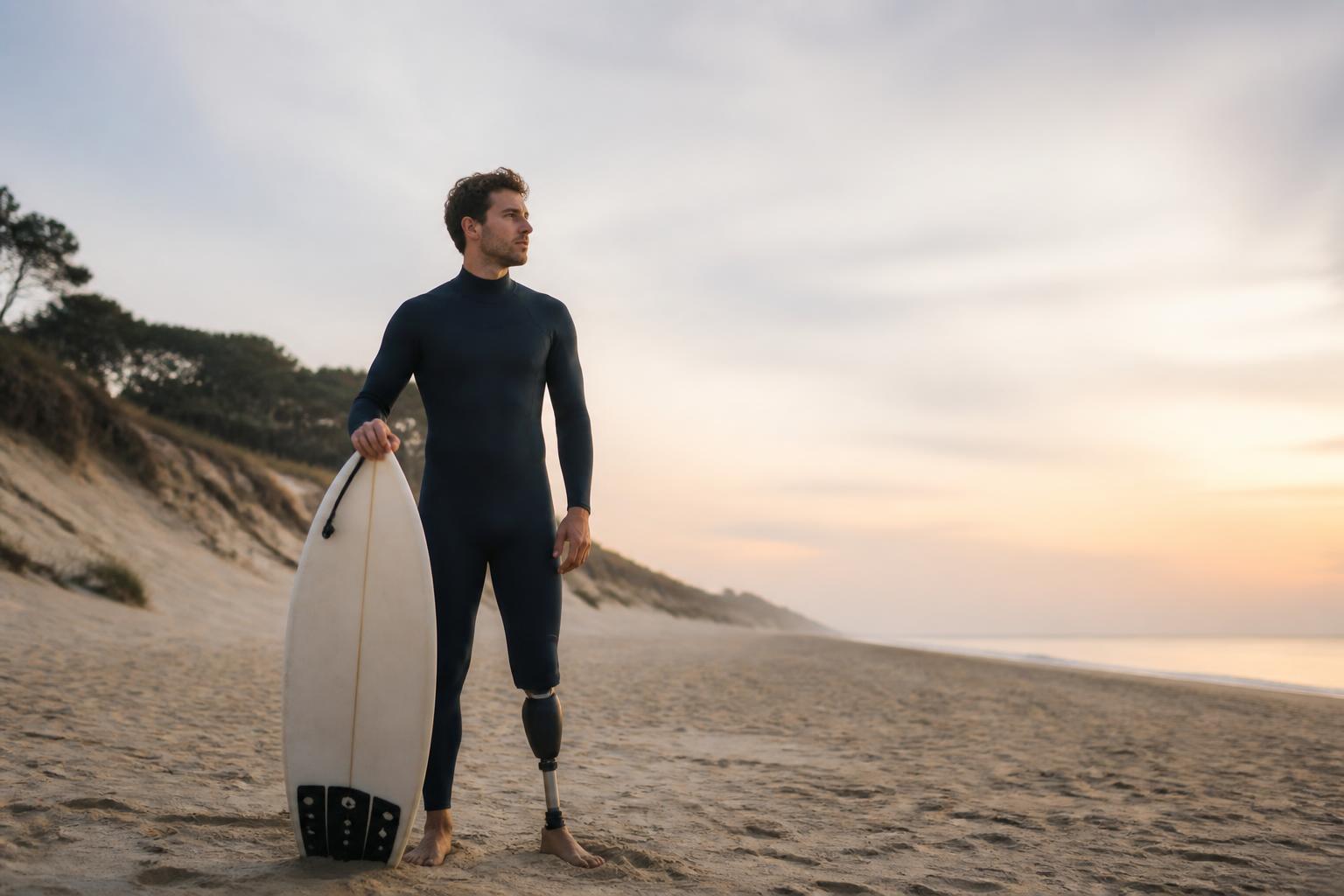
When a multi-title-winning free surfer hits the sand at full speed, the entire Landes community holds its breath. On January 14, 2025, Vincent Duvignac fractures his cervical vertebrae on a sandbar north of Vielle-Saint-Girons. His life is soon in the balance. A year and a half later, he is paddling out again off Hossegor, helmet on his head and a new approach in hand: the search for a new identity as a surfer is underway.
Cervical injury: the wipeout that changed everything
Freezing session, 1.20 m waves, 5°C water: nothing extreme for “Duvi.” In a tight barrel, his head hits the bottom. No loss of consciousness, but a double C1-C2 fracture. Doctors say he narrowly avoided quadriplegia; the man from Landes is already talking about resilience.
A quick timeline of the rehabilitation
A cumbersome neck brace, three months of immobilization, a mandatory stay at the CERS in Capbreton: each stage becomes a personal challenge. Physical therapy alternates mobility work with relearning the duck dive. Between sessions, the surfer checks the conditions on the webcams, keeping his mind firmly focused on the line-up.
High-performance rehabilitation: from the brace to the first take-offs
Getting back to surfing after a cervical injury requires method and discipline. Here is the protocol selected by the multidisciplinary team caring for Vincent:
- Bone stabilization : a custom-molded neck brace for 12 weeks.
- Isometric strengthening targeting the neck and shoulders.
- Low-impact cardio : rowing on an ergometer before returning to the pool.
- Controlled immersion : successive sessions in flat water, then whitewater, then small swells.
- Video analysis to correct neck alignment during the bottom turn.
A new surfer identity: gear, safety, and lineup awareness
The Mimizan rider no longer tackles a slab without thinking about how he turns his head. Board, helmet, yoga routine: everything has evolved. The table below summarizes the before and after.
| Item | Before the accident | After the accident |
|---|---|---|
| Main board | 5’10 round pin, 28 L | 6’0 swallow, 31 L for easier paddling |
| Protection | None | Lightweight helmet + impact vest |
| Warm-up | 10 min of quick stretching | 30 min of flow inspired by surf yoga |
| Wave reading | Maximum risk-taking | Priority given to an angle of attack that protects the neck |
To choose his new boards, he relies on the quiver detailed by Hossegor’s gear specialists. As for the helmet, it became essential from the very first drops in the Landes shorebreaks.
“Out of Line”: the film documenting Landes resilience
Director Pierre Fréchou captures Vincent’s rehabilitation over 37 minutes. Onboard footage during the first whitewater sessions, post-session reflections, a visit to the physical therapist: the documentary brings together everything that echoes the pure passion. Its release at the latest Quiksilver Festival in Capbreton, sparked a standing ovation from the local crew.
What the Landes line-up takes away
1. A helmet takes nothing away from style when the carving remains precise. 2. Fragile cervical vertebrae don’t prevent you from throwing down a tight cutback. 3. The community, from shapers to casual beachcombers, plays a key role in the recovery process.
Why does Vincent Duvignac now wear a helmet?
After the C1-C2 fracture, head protection reduces the risk of direct impact and serves as a constant reminder of the fragility of the cervical area.
What exercises help maintain neck mobility?
Slow rotations, trapezius stretches, and isometric exercises using elastic resistance are part of his daily routine.
Is the documentary “Out of Line” available online?
A short version can be viewed on Oxbow’s YouTube channel, while the full version is making the festival rounds ahead of a VOD release planned for late 2026.
Can you take part in a training camp with Vincent after his accident?
Yes; he leads clinics in Mimizan, where safety, spot selection, and body awareness are central.